Choosing the Right Respiratory Protection: Exploring Types, Understanding Filters, Acknowledging Limitations, and Mastering the Fit Check
Welcome to our comprehensive guide on selecting the appropriate mask for your needs.
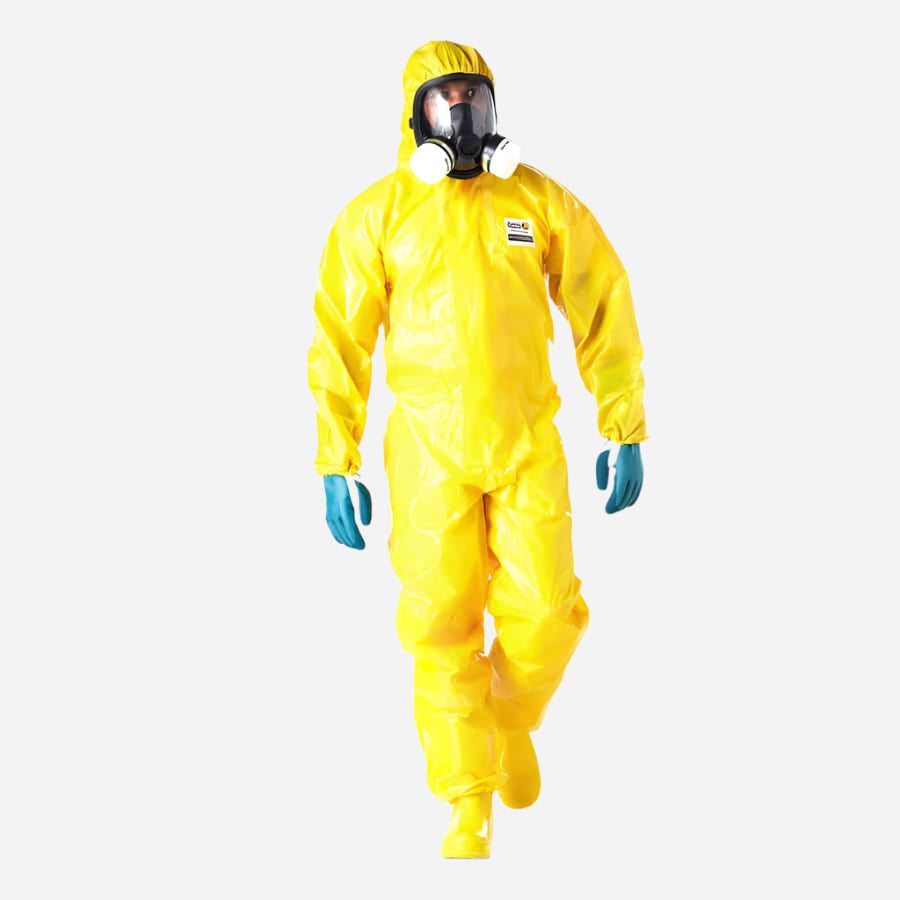
– Type 3, 4, 5 & 6 disposable coverall
– Yellow polyproplyene and polyethylene foil fabric
– Ultrasonic welded & taped seams preventing permeation, dust & liquid ingress
– Double zip & storm flap for secure front protection
– Double elasticated cuff with thumb loop
– Double layer cushioned knee pads for comfort & durability
– Protects the arms, legs, torso & head from the hazards of light liquid sprays, chemical splashes & sprays, airborne solid particulates, radioactive contamination, anti-static dissipation & infective agents contact
– Resistant to penetration by blood/fluids, wet bacterial penetration, biologically contaminated aerosols & powders
– Permeation and chemical penetration protection against a basic range of chemicals: Sulphuric Acid: 96% Class 6 (Permeation), Class 3 (Penetration); Sodium Hydroxide 10% Class 3 (Penetration); Xylene – Class 3 (Permeation); 1-Butanol – Class 3 (Penetration)
– Performs with the requirements of CE type examinations, PPE Directive, 89/686/EEC
– EN ISO 13688:2013 Protective clothing – general requirements
– EN 14605:2005 + A1:2009 Protective clothing against liquid chemicals – Performance requirements for clothing with liquid-tight (Type3) or spray tight (Type 4) connections, including items providing protection to parts of the body only (Types PB (3) and PB (4))
– EN 13034:2005 + A1:2009 Protective clothing against liquid chemicals – Performance requirements for chemical protective clothing offering limited protective performance against liquid chemicals
– EN ISO 13982-1:2004 + A1:2010 Protective clothing for use against solid particulates – Part 1: Performance requirements for chemical protective clothing providing protection to the full body against airborne and solid particulates
– EN 1073-2:2002 Protective clothing against radioactive contamination – Requirements and test methods for non-ventilated protective clothing against particulate radioactive contamination
– EN 14126:2003 + AC:2004 Protective clothing – Performance requirements and test methods for protective clothing against infective agents
– EN 1149-5:2008 Protective clothing – Electrostatic properties – Part 5: Material performance and design requirements
– Agriculture
– Butchery & Food processing
– Brewing industry
– Cleaning industry
– chemical industry
– Healthcare
– Painting
Pickup available at 60 All Black Road
Usually ready in 24 hours

Welcome to our comprehensive guide on selecting the appropriate mask for your needs.

When it comes to safety eyewear, compliance with international standards is crucial to ensure optimal protection and reliability.

Workwear is a vital part of personal protective equipment (PPE), ensuring safety and comfort in demanding environments.